Waikōloa Green Goes Before the Leeward Planning Commission, and the Evacuation Question Finally Gets Asked
On June 18, the Leeward Planning Commission took up Waikoloa Green LLC's request to move its 700-acre property mauka of the village toward development. The applications included a State Land Use District Boundary Amendment reclassifying land from Agricultural to Urban, along with several Change of Zone requests. The plan calls for around 400 multifamily units, 275 family-agricultural lots across 320 acres, sixteen 10-acre lots that could hold a food hub or a renewable energy project, and about 110 acres kept as open space for trails.
We submitted written testimony in opposition.
Not to the housing, and not to this parcel ever being developed. Our position was narrower than that, and we said so plainly: we oppose reclassifying this land to Urban so that hundreds of new households can be built above and feeding into a community with one functional way out, when the application in front of the Commission contained no wildfire or evacuation analysis of any kind.
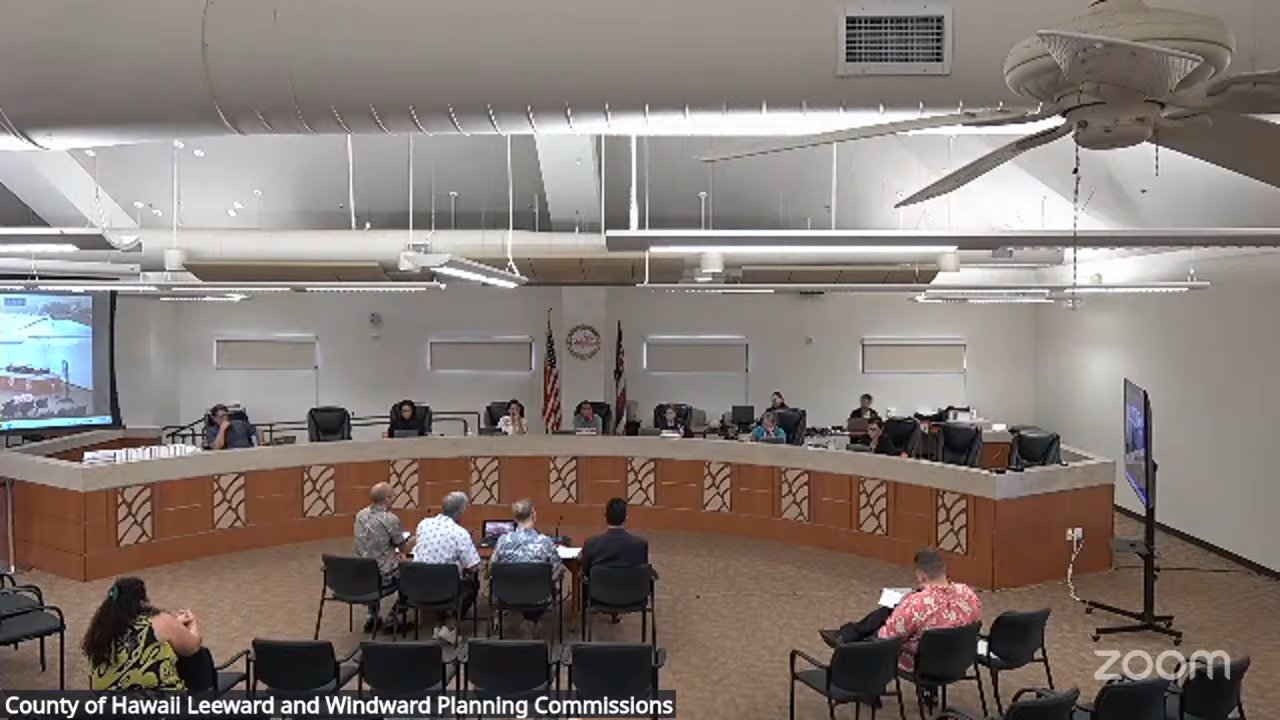
image from Leeward Planning Commission video livestream on June 18, 2026.
The application leaves out wildfire.
That gap was the center of our objection. The applicant's environmental report examined flood, tsunami, and volcanic hazards, as well as unexploded ordnance, from the old Waikōloa Maneuver Area. It did not look at wildfire. It did not look at evacuation.
Meanwhile, the applicant's own botanical survey describes the parcel as completely covered in grasslands, dominated by buffelgrass and fountain grass. Anyone who lives here knows what that fuel does. It is the same flashy, fast-moving grass that carried the 2021 Mana Road Fire and the 2023 Lāhainā fire. The Hawaiʻi Attorney General's FSRI Phase 2 report put Waikōloa's wildfire risk slightly above Lāhainā's before its tragedy. A record that discusses flood and tsunami while staying silent on the one hazard that has already pushed this community onto the road is not a complete record.
The infrastructure that "can reasonably be provided"
The standard the Commission has to apply asks whether the area is served by infrastructure that either exists or can reasonably be provided. For Waikōloa, the infrastructure that matters most is the ability to get out. The applicant's own Traffic Impact Analysis Report relies on two regional road projects to make its numbers work, and neither has been built or funded.
The first is the Daniel K. Inouye Highway Extension, a corridor studied since 1999, put on hold in 2018 for lack of funding, and only recently reinitiated. According to HDOT's own Spring 2026 information sheet, the environmental review runs through 2028, and construction is not scheduled until 2031 to 2035, a timeline the Department notes is subject to change. No preferred route has been selected, and the alternatives on the map end near the resort and Queen Kaʻahumanu Highway, separate from the village.
The second is a full Waikōloa Village second access tied to a different developer's private project. The Traffic Impact Analysis Report itself states that there are no set plans for when the second access would be completed and that the final road alignment is unknown. Infrastructure that the County cannot actually rely on cannot carry the weight of an Urban reclassification.
We also pointed out that this very parcel is the site of the former Waikōloa Highlands project, entitled for roughly 400 units that were never built, which is why the State reverted the land to agricultural use in 2019. An entitlement in Waikōloa has never been a road, a home, or a way out.
At the hearing
WSA member David Foster testified in person and reminded the Commission that the private-land agreements are only half the road. The other half crosses county land to reconnect to the village, and it is unclear how committed the County really is to finishing it. He also made the point we keep returning to: the access roads under discussion, including Hulu, are for emergency egress only. They are not a permanent second road.
The applicant's representative, Jon Yoshimura, spoke to his own family's loss in the Lāhainā fire and said he does not want anyone to go through that. When the Commission asked whether he saw the evacuation problem as being solved before or after the project is built, he pointed to the housing and the new shopping center already underway. He said that stopping to wait would not be fair.
The Commission voted to give Waikōloa Green a positive recommendation. As a condition, they asked that the developer include an update on the evacuation road in its required Annual Progress Report to the Planning Director.
Where that leaves us
We take the condition as a small opening. For the first time in this process, a developer is on record being asked, year after year, to report on the second road. That is not the regional evacuation analysis we asked for, and it does not build the road. But it does keep the question in front of the County instead of letting it disappear into a traffic study nobody reads.
We will keep showing up.
Wildfire Safety Advocates of Waikōloa