A Critical Step Forward, But Our Work is Not Done
Article Summary.
"Trump wildfire prevention work in Waikoloa, a high-risk power line area" (Hawaiʻi Public Radio, Feb 19, 2025)
A recent article from Hawaiʻi Public Radio highlights a significant and welcome development in our community's ongoing fight against wildfire risk. The piece reports that work has begun to replace and "fire-harden" the aging wooden power poles along the critical transmission line that runs through Waikoloa Village with new, fire-resistant steel poles.
This project, managed by Hawaiʻi Electric Light (HELCO) and funded by a federal grant from the U.S. Department of Agriculture, specifically targets the Waikoloa region, a region known for its high fire risk due to dense, dry vegetation and powerful winds.
The article notes that this line, which serves as the sole power source for Waikoloa Village and the Waikoloa Beach Resort, has been identified as one of the utility's highest-risk circuits on Hawaii Island. The upgrade includes stronger poles, more spaced-out wiring to prevent arcing, and the installation of faster-acting shutoff devices designed to de-energize a fault within seconds.
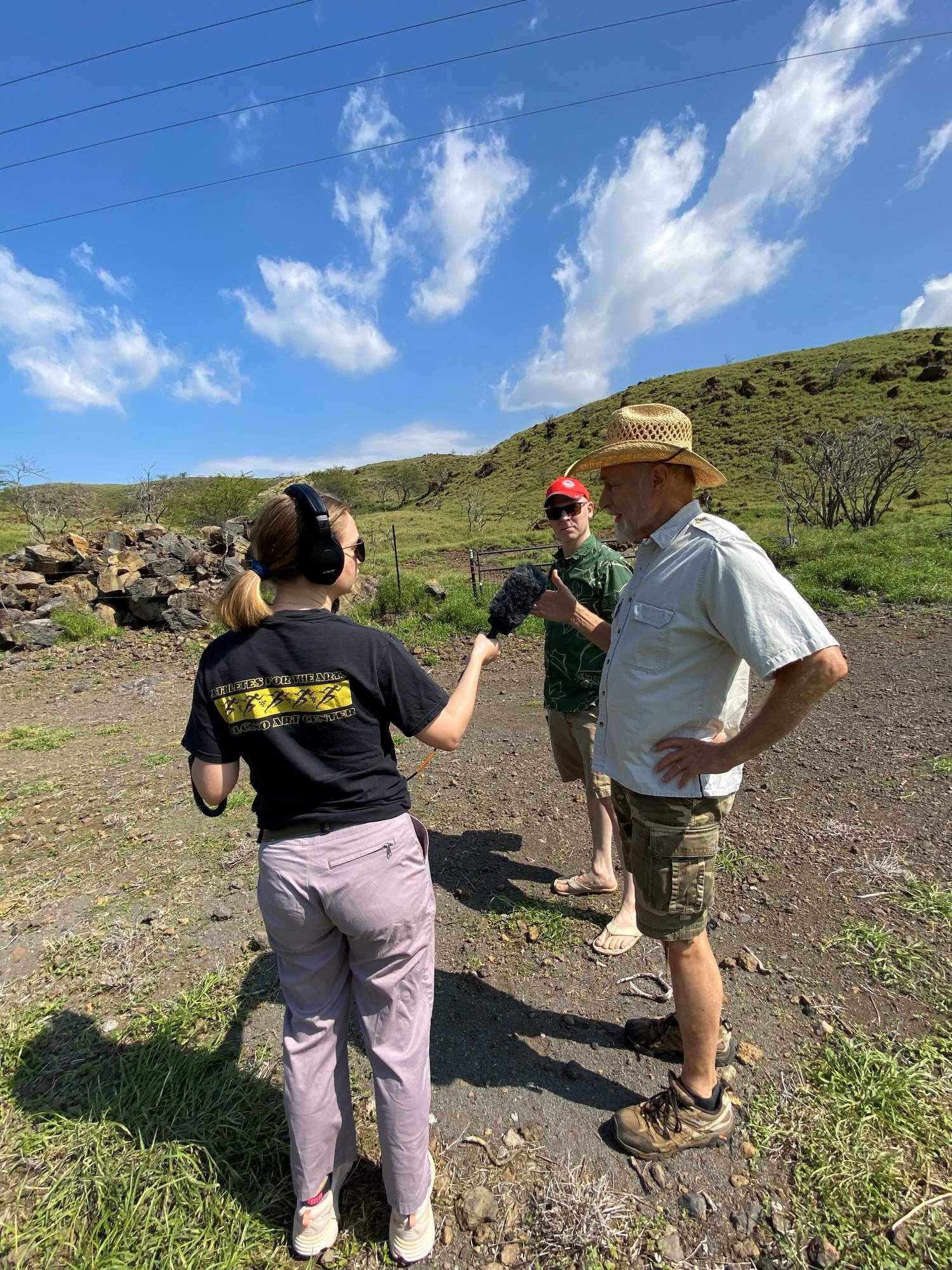
Wildfire Safety Advocate Members Bob Yuhnke and Matt Chalker being interviewed by HPR’s Savannah Harriman-Pote.
Our Thoughts as Wildfire Safety Advocates:
This is a Win We've Championed: For years, our advocacy group and concerned residents have pointed to these very power lines as a glaring vulnerability. Seeing this project come to fruition is a direct result of persistent community pressure and the hard work of agencies taking our concerns seriously. We applaud this critical investment in our community's safety and resilience.
Infrastructure is Just One Piece of the Puzzle: While hardening power lines is arguably the single most effective step to prevent utility-ignited fires, we must remember it is not a silver bullet. Our fire risk is a complex combination of factors: invasive grasslands, drought conditions, and high winds. This infrastructure upgrade must be paired with aggressive and well-funded vegetation management programs across both public and private lands. We urge HELCO and county and state agencies to maintain their commitment to clearing hazardous fuels along all rights-of-way.
The Need for Redundancy and Resilience Remains: The article underscores a sobering point: this is our only transmission line. A catastrophic fire—whether sparked by a downed power line, an accident, or lightning—could still sever this link, leaving our entire community in the dark for an extended period. This project reduces the chance of a spark, but it does not eliminate the consequence of an outage. This reinforces our community's critical need for exploring redundant power sources and individual emergency preparedness, including solar-battery systems and robust evacuation plans.
In Conclusion:
Non-profit work in the Trump era is going to be harder than ever. We will continue to fight for funds to progress Waikoloa Village towards a more fire resilient community. We must view this not as the finish line, but as a strong foundation upon which to build a truly comprehensive and resilient wildfire defense system for Waikoloa.
Let's use this momentum to continue pushing for expanded vegetation management, community-wide preparedness education, and policies that address the full scope of the wildfire threat we face.
Stay safe, stay vigilant, and stay involved.
Read the full article from Hawaiʻi Public Radio here: Trump wildfire prevention work in Waikoloa, a high-risk power line area